
Christopher Nolan's The Odyssey Zeus' Law Explained

The Odyssey—What is Zeus' Law: Meaning Origin
There are a few virtues that could be considered the pillars of Greek mythology and Xenia is one of them.
Xenia is a moral obligation that governed the host-guest relationship. The host must be hospitable and welcome their guests, providing them with food, drinks, bath, and shelter regardless of who they are, therefore they must wait until after providing the above to ask for their guests' names; in turn, the guests must be gracious: they shall respect their hosts, they mustn't abuse their hosts' generosity, and shall not overstay their welcome. The host and guest usually part with gifts.
The Odyssey—What is Zeus' Law: Violations of Xenia
While Xenia is a very integral part of the original story of The Odyssey, it is very different from the way Nolan depicted it. You could argue that Odysseus is one of the heroes in Greek mythology and not interpreted as this guilty sinner as Nolan had shown, he is known for his wisdom, one of the reasons why Athena favored him. The Greeks are condemned for their pillage of the city after entering Troy, but Xenia was actually broken way before that.

As Menelaus' guest, Paris betrayed his hospitality by stealing his wife, Helen. This was the justification behind the war launched against Troy—that is, if having your wife kidnapped was not a reason enough to fight someone. And if you are wondering why all the Greeks mobilized instead of just Sparta which Menelaus ruled, perhaps with the addition of Mycenae as it was ruled by his brother Agamemnon, this is due to the Oath of Tyndareus. As the most beautiful woman, Helen had many suitors and they all took the oath, pledging to protect her final husband from any harm caused from the dispute of their marriage.

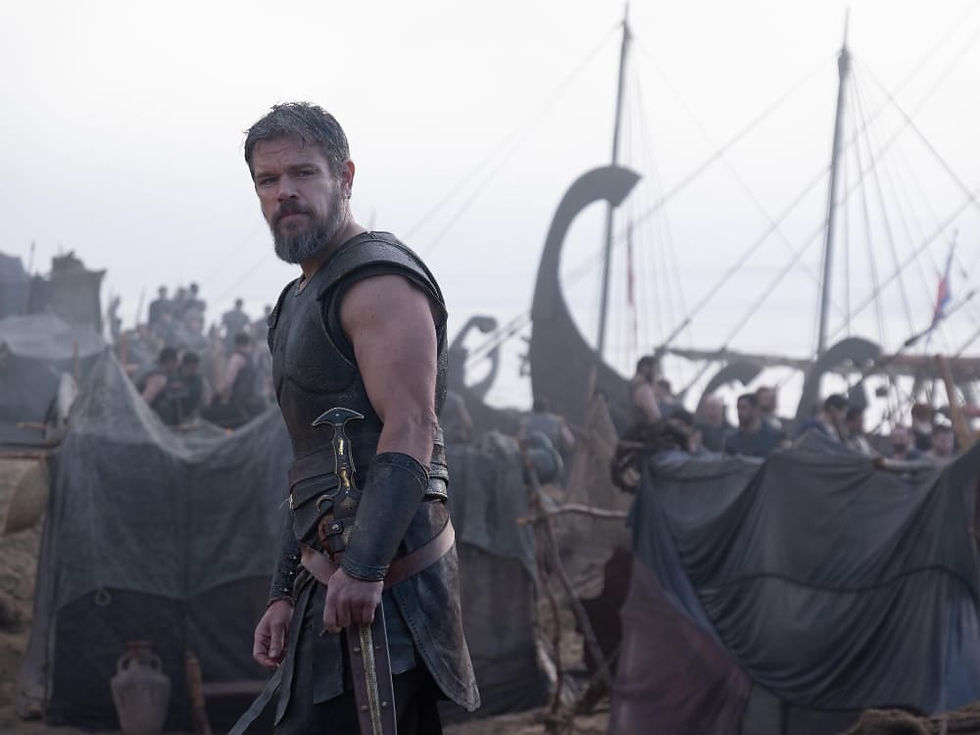
The suitors of Penelope also violated Xenia by grossly overstaying their welcome and deserved revenge being taken upon them. In Nolan's version of The Odyssey, Odysseus (Matt Damon) was eventually exiled for killing the suitors and was accompanied by Penelope (Anne Hathaway). In the original story, Odysseus had done nothing wrong for killing these bad guests and by the end of the poem, he remained in Ithaca. However, there is the prophecy from Tiresias telling him to carry an oar inland and make a sacrifice to Poseidon to appease the Sea God's anger so that he may die peacefully in old age.

The most famous violator of Xenia in Homer's poem would actually be the Cyclops Polyphemus. Odysseus and his men were his guests yet he trapped and ate them. When Odysseus begged for mercy citing Zeus Xenios, Polyphemus said that Cyclopes do not care about Zeus as they were stronger than Gods. In one line, Polyphemus violated 2 crucial virtues in Greek mythology, he had both broken Xenia and exhibited hubris. This being one of the reasons Zeus remained in Odysseus' favor despite Polyphemus being the son of Poseidon. Interactions between Polyphemus and Odysseus were not shown in the movie, turning Odysseus from a hero that saved his crew into the one who is to blame for offending Poseidon. But that's a story for another post.
The Odyssey—What is Zeus' Law: Historical Origin
There are many states making up ancient Greece, we can see Sparta (ruled by Menelaus), Mycenae (ruled by Agamemnon), and Ithaca (ruled by Odysseus) simply in this movie. There are also many scattered islands in the vicinity. There were no established hotels, inns, or police. Following Xenia ensured that travelers can have a roof over their heads and food in their bellies when far from home while protecting the safety of the hosts.
The Odyssey—What is Zeus' Law: Name Origin
It is believed that Xenia is a rule that is maintained by Zeus Xenios, hence being called "Zeus' Law" in the movie. Saying "Xenia" might be confusing for those without the prior knowledge and saying "hospitality" is not strong enough for viewers to understand that it is an enforced rule.

In the movie, it was mentioned multiple times by both Telemachus (Tom Holland) and the suitors that a beggar might be a God in disguise, which wasn't really the main reason that Xenia was supposed to be upheld in the first place. This could be the movie trying to honor Homer. The original story of The Odyssey starts with a God in disguise. Athena visits in disguise and is hosted by Telemachus.
Towards the end, after Antinous throws a stool at the disguised Odysseus, a suitor does indeed rebuke him saying the Gods take the form of strangers and wander cities, just as in the movie.
The Odyssey—What is Zeus' Law: Gods in Disguise
There are many stories of Gods being in disguise but the most notable ones involve Zeus. The following were three similar stories from different sources but merged into one by the people in retellings.

Just as legends from other regions and religions with a major apocalypse, such as Noah’s Ark from the Bible and Nüwa mending the sky in Chinese mythology, the Greeks also had their version of a massive flood that killed humanity.
Years after Prometheus created humans from earth and was punished for stealing fire, Zeus looked down on the world and noticed that humankind seemed to have become corrupt. He considered wiping out all mankind of the Bronze Age, Hermes urged him to reconsider and proposed that they visited 3 households in disguise. If 2 out of 3 were indeed as bad as they've heard, then they shall proceed with Zeus' original plan. So Zeus and Hermes came down to earth pretending to be travelers looking for food and shelter.
Their first stop was Arcadia which was ruled by the King Lycaon, known to be savage and evil with fifty sons that were mostly the same as him. Worst of all, rumor has it they were cannibals.

When Zeus and Hermes reached the palace, they were welcomed into Lycaon's palace, not out of the goodness of his heart but because he noticed that Hermes was young and handsome, perfect to be served in a feast. As Zeus and Hermes took shelter in Lycaon's palace, his youngest son, Nyctimus, who had always refused to consume human meat like his father and brothers, mustered up the courage to tell his father that it would be abhorrent to harm a guest under their roof. In response, Lycaon made Nyctimus into a pot of stew and served him to the Gods. Being the king of the Olympians, Zeus immediately knew what was in the bowl in front of him. He turned Lycaon into a wolf to wander in the mountains of Arcadia, struck down Lycaon's fifity sons with lightning, and resurrected Nyctimus, making him the new King of Arcadia.

Next, the gods came to the doorstep of an elderly couple by the name of Baucis and Philemon. Despite not having much themselves, the kind couple decided to greet their guests, offering them food and wine. Miraculously, they realized that their guests' wine cup automatically refilled itself. They fell to their knees realizing that they were in the presence of Gods. Zeus rewarded their kindness by asking them what they wish for as a gift. The couple asked to be the priest and priestess of the God's temple and to die at the same time so that they will never be apart. Zeus granted their wish and restored their youth so that they may live a life together once again, then when they died, they instantly turned into intertwined trees that remained bowing in front of the temple.

The final visit was what would determine the fate of mankind, and Hermes, perhaps hoping to salvage humans, led his father to the King and Queen of Thessaly, Deucalion and Pyrrha. Deucalion is the son of Prometheus while his wife, Pyrrha is the daughter of Epimetheus (Prometheus' brother) and Pandora. The couple was living a virtuous life honoring the Gods and treated Zeus and Hermes with hospitality. Before returning to Olympus, Zeus told Deucalion that he would summon a great flood which will drown all those that are not fit to be alive and for Deucalion to build a ship with a lid and stock it with provisions.

After the flood, the couple was told by the oracle that this wasn't meant to be the end of mankind, they shall cover their heads with their cloaks and cast behind them the bones of their mother. Naturally, Deucalion and Pyrrha did not have the same mother but they soon realized that as all mankind was created from clay formed by earth, their mother is earth and the bones of earth must be stones. So the couple covered their heads and threw stones over their shoulders behind their back, every stone that landed on the ground turned into a new person, the stones Deucalion threw turned into men and the ones Pyrrha threw turned into women, and that’s how mankind repopulated.
--
Don't forget to follow me on Instagram–Cherie Aria🧜🏻♀️ 艾雪莉
Lifestyle and workout: https://www.instagram.com/cheriearia/